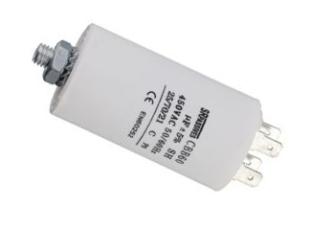
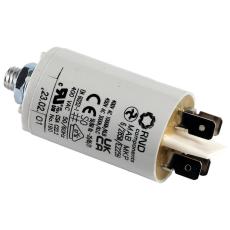
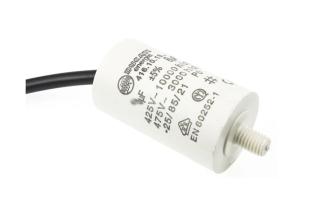
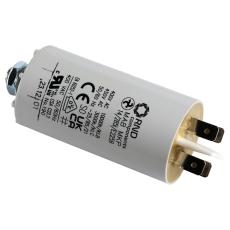
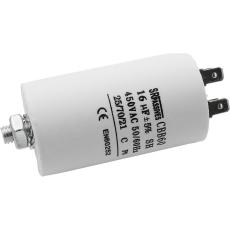
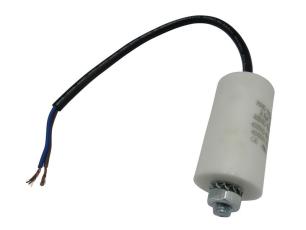
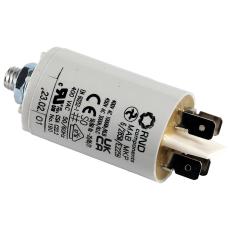
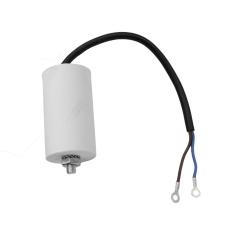
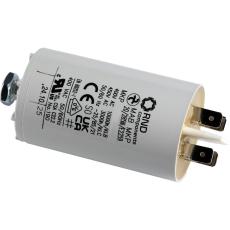
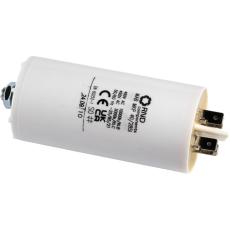
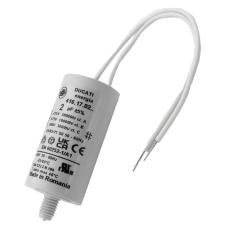
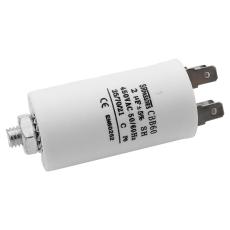
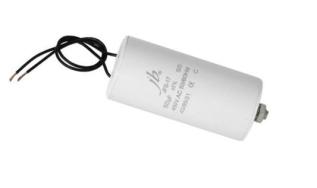
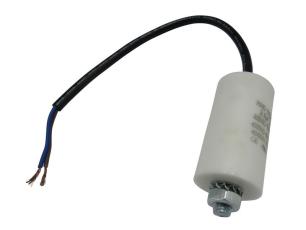
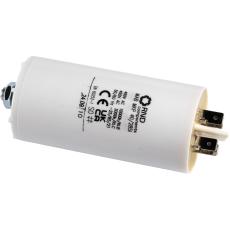
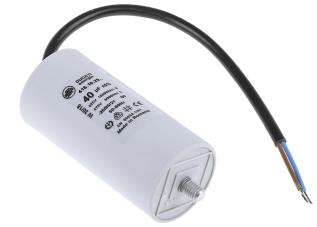
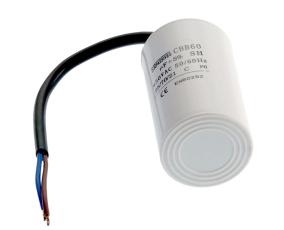
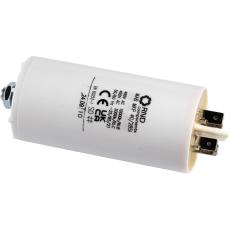
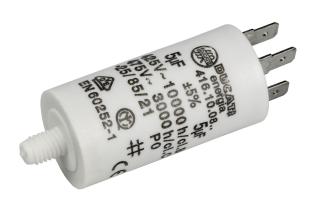
Motor and run capacitors
AC motors in ventilation fans, compressors, tools, dehumidifiers, pumps, dryers, radon extractors, etc. use capacitors. There are two ways that motor capacitors are used: either as a start capacitor or a run capacitor. The two types are actually the same kind of capacitor, only used for completely different reasons and (normally) with different capacitances. Run and motor capacitors are both parts that have a limited lifespan, eventually they wear out. When they go bad, it will become noticeable through symptoms such as increased humming, the motor not starting, fuses tripping upon start, or that the motor becomes “weak” and runs slower when loaded.
Start capacitors – a jump start
Start capacitors are used to help AC motors get started, giving an extra push to the motor during start-up. When a motor has reached around 70-80% of its speed, where it can manage on its own, the start capacitor is automatically disconnected. Disconnection of the start capacitor is done with an electronic or mechanical centrifugal switch. Typically, start capacitors have a significantly higher capacitance than run capacitors.
Can you replace a start capacitor with a new one with a higher capacitance?
Sometimes – the ideal is always to choose the same capacitance, but a capacitor with 10-15% higher capacitance will usually work well, if the exact value isn’t available.
Run capacitors – power factor correction
Run capacitors are always active, and are used to phase compensation. When an AC motor is used, it becomes an inductive component (by inductive reactance). This means that the current and voltage curves are shifted in relation to each other and end up out of phase – there is a phase shift with a positive cos phi angle. In an inductive load, the voltage comes before the current. When this happens, unwanted reactive power (useless work) occurs and the motor’s efficiency is decreased.
With a run capacitor, this relationship can be corrected. The capacitor has a capacitive reactance, in which the current comes after the voltage, creating a phase shift with a negative cos phi angle. This capacitive reactance thus works against the inductive reactance of the motor. With the help of a run capacitor, the phase shift angle cos phi will decrease. The result is that power factor correction occurs. The ideal power factor is 1.0, meaning that the current and voltage curves are completely synchronised, all the input power becomes useful work. Through calculations, one can find an optimal ratio for the capacitance where the reactive capacitance counteracts the motor's reactive inductance. In this way, we can approach a significantly better power factor – not the ideal of 1.0, but 0.8-0.95 are attainable.
Can you replace a run capacitor with a new capacitor with a higher or lower capacitance?
No, any replacement run capacitor should have the right capacitance for the motor in question. When replacing a capacitor during repairs, it is important to try to find a capacitor with as close a capacitance as possible. An incorrect value will make the motor weaker, while still using the same amount of energy. Small differences of a few percent, e.g. replacing a 12.5 uF capacitor with a 12 uF one, is usually fine, though.





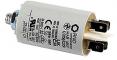

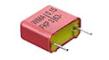


product listing
Observe:
Enter your e-mail address, to recieve a message when the item is in stock