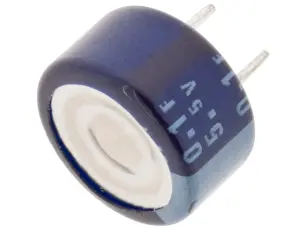
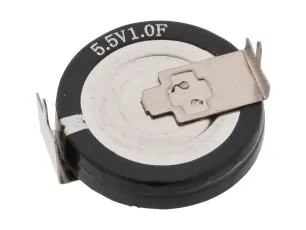
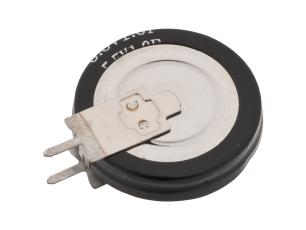
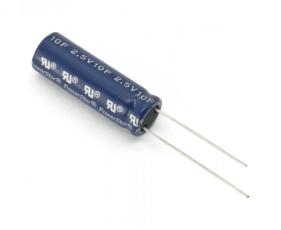
Supercapacitors (sometimes called ultracapacitors) are a kind of hybrid between a rechargeable battery and a regular capacitor. They have significantly higher capacitance than electrolytic capacitors. The capacitance is often given in farads without any prefix – a typical capacitance can thus be several million times higher than those typical för electrolytic capacitors. Supercapacitors can normally withstand up to one million charging cycles, which is considerably more than a rechargeable battery can withstand. Compared to batteries, however, supercapacitors have a significantly lower energy density (Wh/kg).
Common applications for supercapacitors include dealing with power outages, memory backup, and storing braking energy in electric and hybrid-electric vehicles.
The most common technology is EDLC (Electrical Double Layer Capacitor). This technology gives a low voltage rating of only 2.7 V. In order to achieve higher voltage ratings, capacitors are commonly manufactured with several capacitor cells connected in series.
Typical capacitances are 0.1-100 F (farad). Significantly higher capacitances than this are found, for example, in the automotive industry.
Normal operating temperatures are -40 to +60 °C.
Advantages: very fast charging and discharging, very high capacitance, long life, low equivalent series resistance (ESR), low self-discharge (typically a few μA) and low temperature dependence.
Disadvantages: low voltage ratings, linear discharge curve (at 50% discharge the voltage has also dropped by 50%).


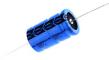


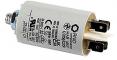

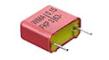


product listing
Observe:
Enter your e-mail address, to recieve a message when the item is in stock