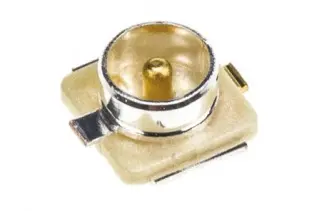
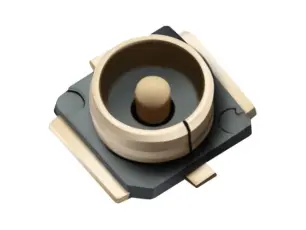
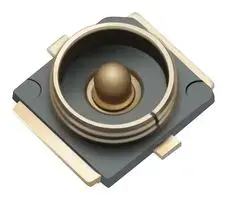
Ultraminiature coaxial connectors
Ultraminiature coaxial connectors are space-saving and high-performance coaxial connectors. Their use increases as even more – and smaller – products are equipped with wireless communication capabilies. Low weight, low cost and small size are characteristics which lend to their use in, for example, drones, IoT devices, GPS receivers, 4G/5G modules for smart cities and other sensor data acquisition, laptops, etc. Often used to connect antennas, they also appear as board-to-board RF signal interconnects.
However, their popularity has a downside, in that there are many different manufacturers and deceptively similar models. There are standardized sizes and widely compatible connectors, but unlike e.g. BNC or N connectors, there is no common naming convention. All manufacturers use different names for essentially identical connectors.
There is even additional confusion surrounding the manufacturer I-PEX, as their product names (and company name) is commonly written in slightly different ways. All variants are listed below, but the manufacturer's own name is the preferred one.
This cross-reference lists the most common connector types and manufacturers. Various information about compatibility abounds on the internet, and many manufacturers choose not to state which competitors their connectors are compatible with, even though the competitor may do so.
We have obtained information from the manufacturers, and verified the vital dimensions in the datasheets. We have not taken the mated height into account, hence it may differ by a few tenths of a millimeter between connectors that are listed as compatible in this document.
|
|
Generation 1 |
Generation 3 |
Generation 4 |
|
Dimensions, pin x ground: |
2.0 x 0.5 mm |
1.4 x 0.4 mm |
1.5 x 0.45 mm |
|
|
|
|
|
|
Hirose |
u.Fl |
w.FL |
|
|
I-PEX |
MHF I |
MHF III / IPX3 |
MHF 4 / IPX4 |
|
Amphenol |
AMC |
AMMC |
AMC4 |
|
Taoglas |
TXR |
TXR3 |
TXR4 |
|
Cinch |
UMC |
|
|
|
Molex |
MCRF |
|
|
All ultra-miniature coaxial connectors have some things in common, e.g. 50 Ohm impedance and a bandwidth of at least 0-6GHz. Some deliver higher bandwidths, but all are capable of e.g. Wi-Fi 7 frequencies.
These connectors often have a short expected lifespan of approx. 20-30 mating cycles, which is why the need a gentle hand, and preferably the use of insertion and extraction tools.
There are three generations of connectors that are in use today.
Generation 1
Generation one is usually called u.FL, which the manufacturer Hirose’s name. Generation one is much larger than newer generations, but still very small compared to e.g. MCX or SMA connectors.
The male connector takes up about 3x3mm of space on a printed circuit board. The outer diameter of the contact sleeve (ground) is 2mm, and the center pins have a diameter of 0.5mm. The mated height is around 2 to 2.5mm in height, depending on the exact model and series.
Compatible connectors include:
Hirose u.Fl, I-PEX MHF I, Amphenol AMC, Taoglas TXR, Cinch UMC, Molex MCRF,
The I-PEX connector is sometimes called MHF1, IPX1, IPEX1 or just IPX.
Taoglas TXR is sometimes called TXR1.
Generation 3
The next generation is generation three – generation two is obsolete. The generation is usually called either w.FL or MHF3. Some manufacturers state that generation three is nearing end-of-life, but not all.
Generation three is significantly smaller than gen 2. The board connectors take up around 1.7x2mm of PCB area. The dimensions of the sleeve and center pin are 1.4 and 0.4 mm respectively. The mated height is usually a maximum of 1.6mm including cable and connector.
Compatible connectors include:
Hirose w.Fl, I-PEX MHF III, Amphenol AMMC, and Taoglas TXR3.
MHF III is sometimes called MHF 3, IPX3 or IPEX3.
Generation 4
The next generation is four, and is often called MHF 4 (or some other variant of that name).
The connectors are overall similar in size as generation three, but the mating parts have different dimensions. Both the sleeve and the center pin in the connector are now slightly larger, 1.5 and 0.45 mm diameters, respectively. However, the mated height has shrunk to approximately 1.2mm including cable and connector.
Compatible connectors include:
IPEX MHF 4, Amphenol AMC4, and Taoglas TXR4.
MHF 4 is sometimes called MHF IV, IPX4 or IPEX4.
Generations three and four are similar enough that one of the connectors can also be mounted on each other’s PCB footprint. Note, however, that orientation markings can vary between manufacturers. All manufacturers seem to indicate different sides for the generations. In the image below you can see how little difference there is between generation 3 and 4, and that the 45° cut corner marking orientation is on different sides in with respect to the signal pin (based on Taoglas’ pin identification).