
Product description
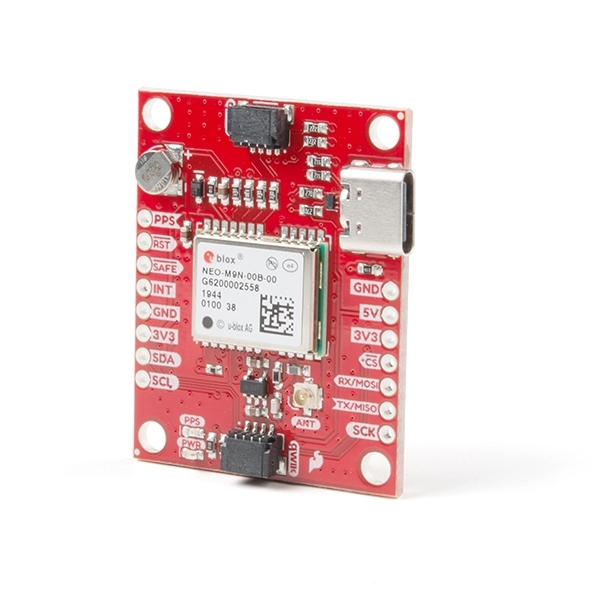
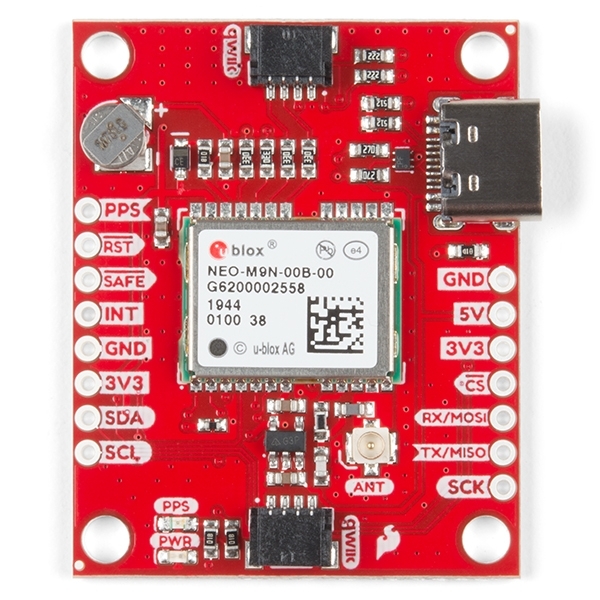
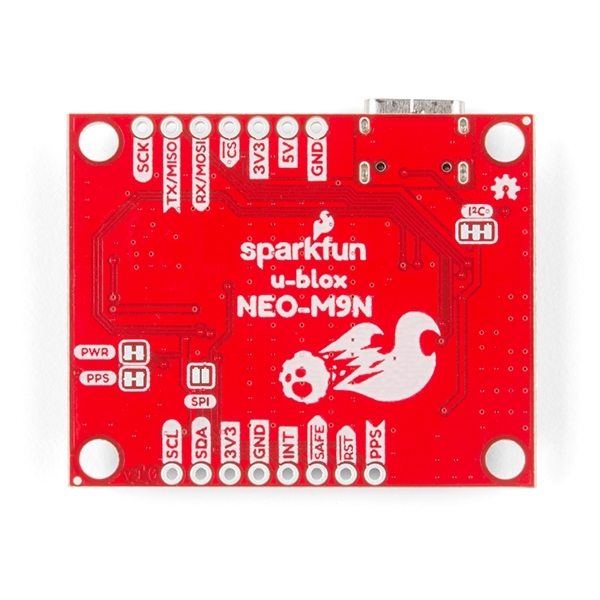
The SparkFun NEO-M9N GPS Breakout is a GPS board with extensive configuration options. The NEO-M9N is a 92-channel u-blox M9 GNSS receiver that can receive signals from the GPS, GLONASS, Galileo and BeiDou constellations with approximately 1.5 m accuracy. The board supports concurrent reception of four GNSS constellations, which improves position accuracy in difficult conditions and reduces lock time.
The receiver supports I2C (referred to by u-blox as Display Data Channel), which makes it Qwiic compatible and leaves the UART ports free for other use. With the Qwiic system, no soldering is required to connect the board to the rest of your system. The board also has 0.1"-spaced pins broken out for breadboard use.
The NEO-M9N module detects jamming and spoofing events and reports them to the host, allowing the system to respond. A SAW filter combined with an LNA in the RF path is integrated into the module, which allows normal operation even under strong RF interference.
The board is equipped with an on-board rechargeable battery that powers the RTC on the NEO-M9N. This reduces the time-to-first-fix from a cold start (~24 s) to a hot start (~2 s). The battery maintains RTC and GNSS orbit data for an extended period without external power.
u-blox based GPS products are configured using the Windows program u-center. Baud rates, update rates, geofencing, spoofing detection, external interrupts, SBAS/D-GPS and more can be configured on the NEO-M9N. All of this can also be done from the SparkFun Arduino Library.
Antenna not included.
- Integrated U.FL connector for the antenna of your choice
- 92-channel GNSS receiver
- 1.5 m horizontal accuracy
- 25 Hz max update rate (4 concurrent GNSS)
- Time-to-first-fix: cold 24 s, hot 2 s
- Max altitude: 80,000 m
- Max G: ≤4
- Max velocity: 500 m/s
- Velocity accuracy: 0.05 m/s
- Heading accuracy: 0.3 degrees
- Time pulse accuracy: 30 ns
- 3.3 V VCC and I/O
- Current consumption: ~31 mA tracking GPS+GLONASS
- Software configurable: geofencing, odometer, spoofing detection, external interrupt, pin control, low power mode and more
- Supports NMEA, UBX and RTCM protocols over UART or I2C